🦇 The Bat-Chat Translator: The new way for humans to engage with bats through glass and sound
A two-way sound interaction system for zoo environments
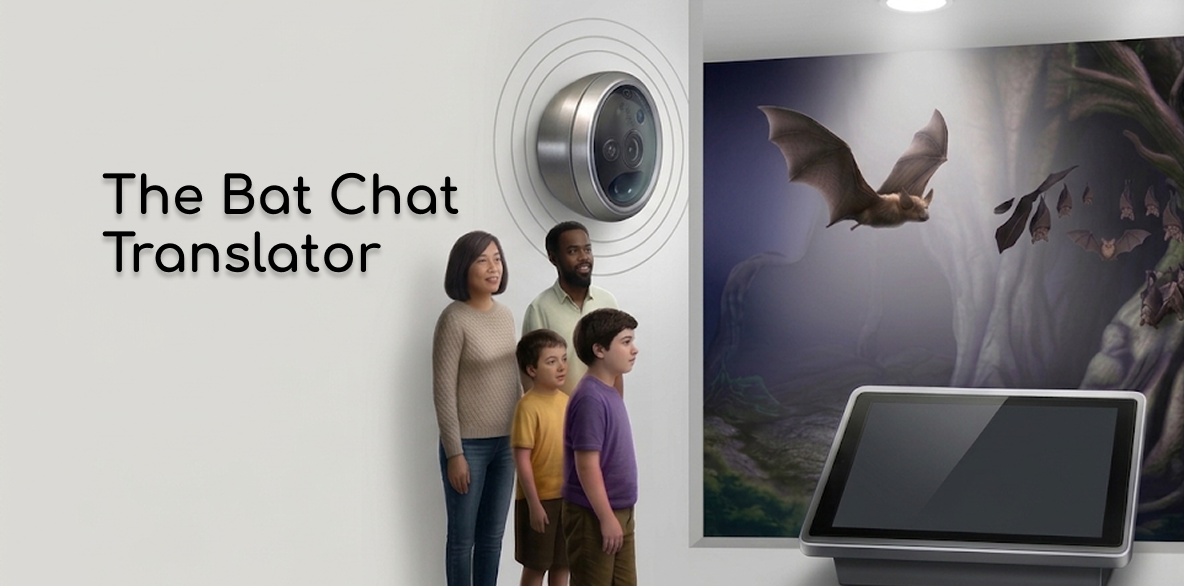

The question
What if the "shhhh" at the bat exhibit, wasn't neccesary anymore?
Most zoo environments are built around one kind of user: the human visitor. Bats, which navigate entirely through sound, are left to exist inside spaces optimized for visual access and crowd flow. Staff enforce quiet zones and dim the lights not to improve the visitor experience, but to limit the damage the environment does to the animals living in it. That friction is where this project started.
Why bats
Bats navigate through echolocation. They emit high-frequency sound pulses and use the returning echoes to construct detailed spatial maps of their environment. Every design decision that prioritizes visual clarity, flat glass, bright lighting, open sightlines, is a decision that makes the space harder for them to read.
This connected directly to my background in special education, where I learned that barriers come from environments, not from the people navigating them. Bats aren't visually deficient. They're sound-dominant navigators living in spaces that weren't built with them in mind.
So studying them felt like a way to stress-test inclusive design thinking beyond its usual human context.
Research
I started my research by using live bat cams from the BatWorld Sanctuary by running ethogram observations across three camera feeds,
- I logged behavior in ten-minute intervals. Observing the activity of the colony.
- By 10:05 PM bats were repeatedly landing on the same nets before taking off again.
- At 10:06, bats roosted side by side after others nudged the other with its wing.
- Small gestures, carried a lot of information about colony social dynamics.
Click Here to view a snippet of the Bat's in Action
I also visited the World of Darkness exhibit at the Bronx Zoo, which houses Egyptian fruit bats, Seba's short-tailed bats, and common vampire bats.
Walking in was immediately disorienting. You lose your visual reference points almost entirely. You become hyperaware of sound. You can hear wing beats from bats you can't see at all. But the thing that stood out most was how staff spent the whole visit managing human presence, keeping visitors quiet, blocking phone light, for the welfare of the animals.
Ideation
After the visit, I started to sketch out ideas for what my my final prototype would be, I ended up with 20 sketches.
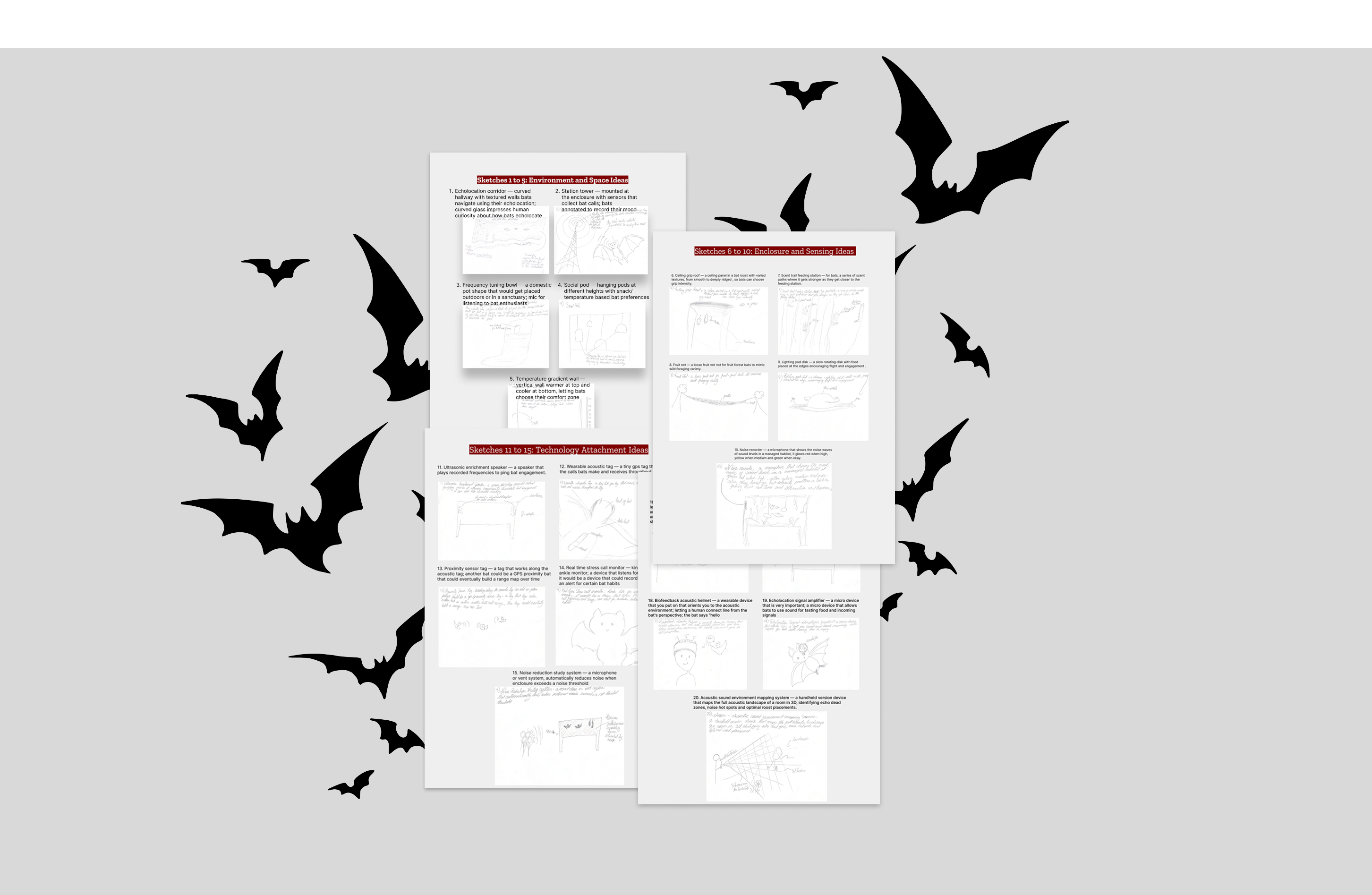
I ivided my design ideas into four main concepts:
- environment and space,
- sensing technology,
- wearable devices,
- and visitor interfaces.
Ideas ranged from temperature gradient walls and ceiling grip roofs to wearable acoustic tags and AI call recognition systems. None of these became the final design on their own, but sketch 11, the ultrasonic enrichment speaker, planted the seed. And the real-time stress monitor from sketch 14 ended up being the piece that made everything responsible.
The solution?
A Rough draft was born, where i drafted an idea of a system that converts human voice into ultrasonic frequencies, that function as echolocation enrichment cues inside the enclosure. Your voice becomes bat enrichment.
.png)
But when I first presented this concept, I was lucky that my classmates asked questions, and I rapidly recognized, my design had flaws;
- “What if this instead of engaging the bats, overstimulates them?
- “How do we actually know if the bats actually like the waves we’re transmitting
- to them?
- “What if bats just don't want to listen to us? Is there an off switch?
- They can’t just opt out, can't they?”
These were just some of the comments, but they helped shift and add strength into my design idea, and eventually help me create an even better design.
The redesign added a designated visiting window so the system only runs during scheduled hours, and a system that anaylzes in real-time the tone before sending out the tone of the human before sending out the waves, to avoid any stress indications. However, if by any means the stress monitor reads the colony's behavior signals re rising before with the translation, the system would shut down automatically. No human override. The bats decide when it ends.
How the redesign works
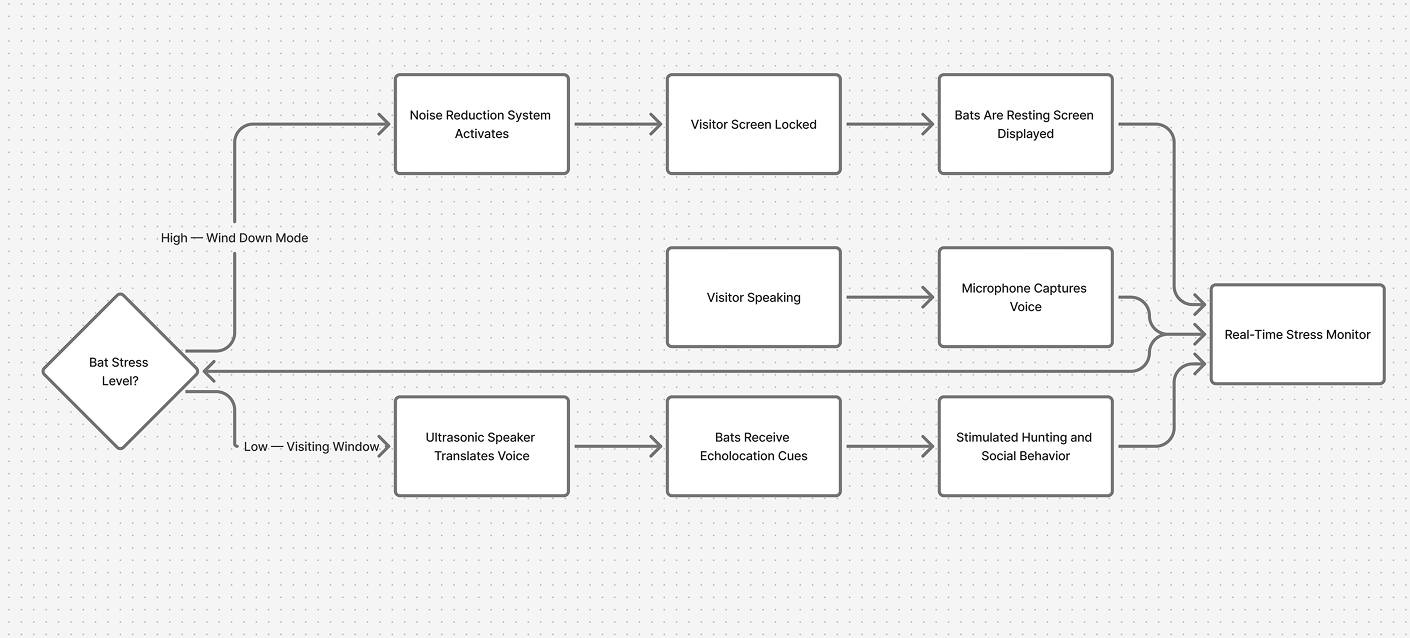
- During a selected hour of the day. Visitors can talk to bats once a day by talking into one specific microphone, only into one specific exhibit, the young fruit bats who are yet learn how to hunt.
- A Microphone captures visitor's voice before it enters the bat's enclosure.
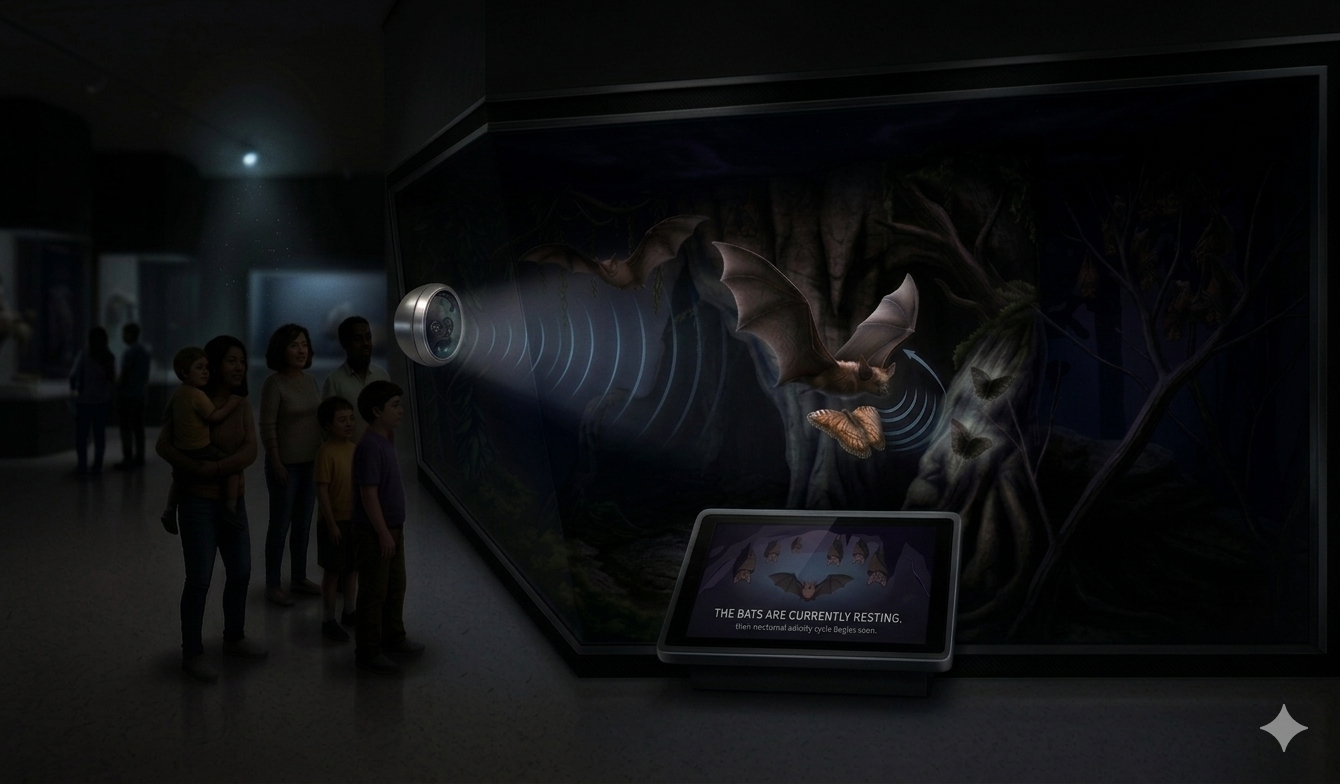
- If bat's Stress levels are low, ultrasonic speaker will capture and translate human sound into bat-range frequencies.
- Then it proceed to Stimulate hunting and social behaviors through sound waves
- If bat Stressors increase;
- Screen Dims, Visitor screens lock
- Bats resting screen is displayed,
- No override allowed, No staff needed.
- A real-time stress monitor acts as the gatekeeper.
- Visitor input only reaches the enclosure when bat stress is low and the designated visiting window is active.
The interface & Final Design
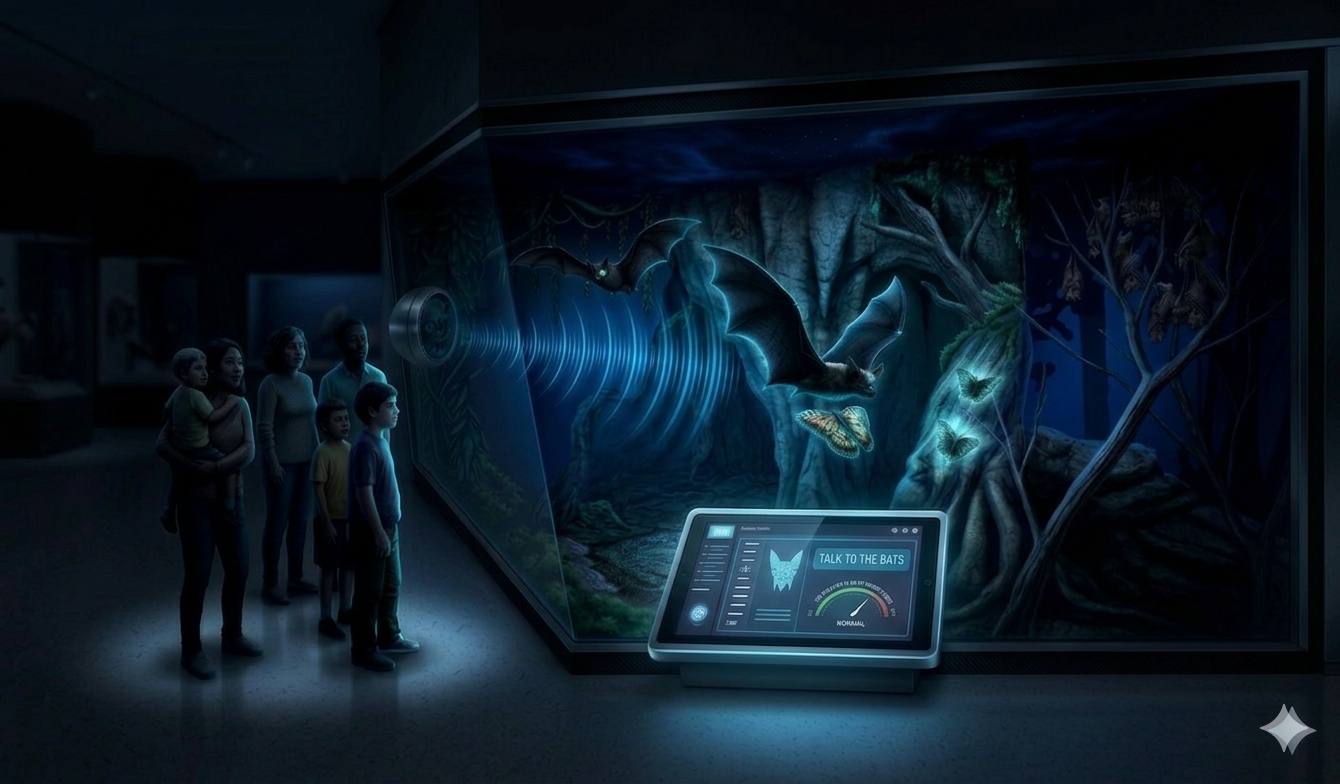
When stress is low the kiosk is live, visitors can speak, and the system transmits. When stress elevates the button locks, the screen shifts to a resting state, and everything goes quiet automatically.
The whole concept of the redesign centers on bat wellbeing, which is taken into consideration across every aspect of the physical enclosure. On the visitor side, dimpled glass is used rather than flat glass. Flat glass reflects echolocation signals directly back at bats, creating acoustic confusion. A textured surface scatters those signals instead, making the space more navigable for the animals on the other side.
What I took away
I spent a semester designing for a user who can't fill out a survey, sit in a focus group, or tell me whether I got it right. Bat's can't fill out feedback forms, or tell me wether I'm doing a good job.
When a user cannot advocate for themselves, the ethics of the interaction cannot live in a disclaimer or a checkbox. They have to follow a different structure from the one i'm accustomed to as a designer. I learned how to design for a user that I never thought I would ever design for, and I came into this work learning how to design in another level of inclusivity I didn't think I was capable of being inclusive.
That being said, users do not always speak. They do not always fit the assumption the word was built around. But they are still there, still navigating the world, still affected by what we build.
I just had to learn to listen differently. 🦇
Proven Results Across Real Applications
See other amazing case studies


